
News: AUA Hosts Inaugural ETICA Conference on ‘National Identity in a Time of Crisis’
YEREVAN—The recently launched Center for Ethics in Public Affairs, based at the American University of Armenia’s Turpanjian Institute of Social Sciences, on June 29 and 30 hosted its inaugural international conference on “National Identity in a Time of Crisis.” The two-day timely event engaged with the complex question of national identity in Armenia and beyond through presentations by over 60 Armenian and international scholars, including six keynote speakers, in the presence of nearly 200 attendees from Armenia.

News: AUA’s ETICA Center will promote research and public discourse on ethical issues
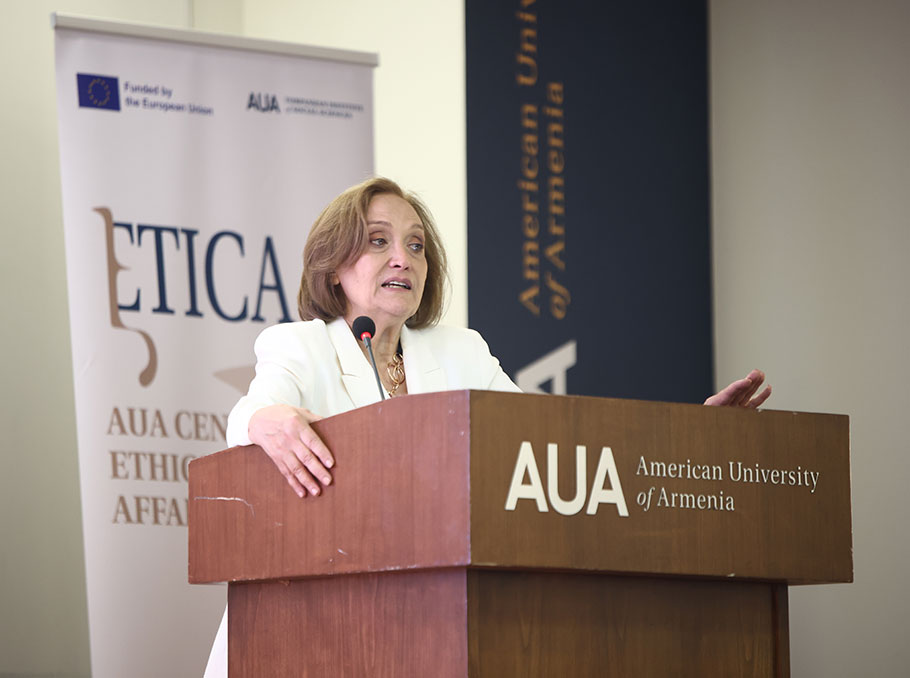
The American University of Armenia is pleased to announce that Professor Maria Baghramian has joined the University as head of the Center for Ethics in Public Affairs (ETICA), a pioneering initiative established with a €2.5 million grant from Horizon Europe’s prestigious European Research Area Chair program.

News: Professor Maria Baghramian Joins AUA to Lead ETICA

The American University of Armenia is pleased to announce that Professor Maria Baghramian has joined the University as head of the Center for Ethics in Public Affairs (ETICA), a pioneering initiative established with a €2.5 million grant from Horizon Europe’s prestigious European Research Area Chair program.
News: Baghramian to Create Center for Ethics in Public Affairs in Armenia
Maria Baghramian, currently professor of philosophy at University College Dublin, will be moving to the American University of Armenia for a five year period in order to take up a position as European Research Area Chair and establish and direct a Center for Ethics in Public Affairs (“ETICA”) at the university.
The initial funding for the position and center comes from a € 2,499,453 (approximately $2.6 million) “Horizon Europe” grant from the European Commission.
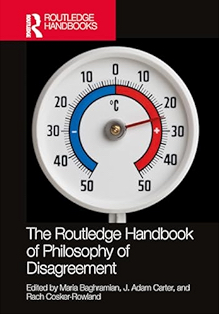
New Book: The Routledge Handbook of Philosophy of Disagreement (2024)
Disagreement is one of the deepest and most pervasive topics in philosophy; arguably its very bedrock, and is an ever-increasing feature of politics, ethics, public policy, science and many other areas. Despite the omnipresence of disagreement, the topic itself has received relatively little sustained examination.
This outstanding handbook examines the philosophy of disagreement and how it extends to debates in public policy and science.
CONFERENCE: Wittgenstein, Newman, and Hinge Epistemology
Monday 9th and Tuesday 10th December 2024.
The conference, organised jointly by UCD Newman Center for the Study of Religions and the PERITIA Nework of Resech on Trust and Expertise, explores the connections between the area of research in epistemology known as “hinge epistemology”, inspired by the last writings of Ludwig Wittgenstein, and the views of philosopher and theologian St. John Henry Newman (1801-90), with a view to developing new insights both into hinge epistemology and Newman studies.

Experts – Part II: The Source of Epistemic Authority (2024)
This paper investigates the topic of epistemic authority from the perspective of the ordinary people facing expert testimony. In particular, two central questions are discussed: how one should respond to expert testimony; and what should one do before expert disagreement.
Experts – Part I: What They Are and How to Identify Them (2024)
This paper investigates the topic of expertise in cognitive domains from a socio-epistemological perspective. In particular, two central questions in the epistemology of expertise are discussed: what an expert is according to extant theories on the market; and how ordinary people can identify an expert in domains in which they have no competence of their own.
Filosofía ULL
CONFERENCE: 12th – 14th Nov 2024
Reading Putnam by Maria Baghramian
The workshop aims to encourage the exchange of ideas and academic debate through the presentation of contributions related to any of the philosophical themes of our keynote speaker Maria Baghramian. Professor Baghramian’s lectures are as follows: “Trust and Hope in a time of Crisis,” “The Role of Externalism in Putnam´s Many Realisms,” “Expertise, Knowledge Resistance and the Value of Epistemic Autonomy.” For more information, please contact the organizing committee at pointsov@ull.edu.es. Read more…

CONFERENCE: 9th – 11th Sept 2024
The PERITIA Network at UCD and SciDem (the University of Oslo’s Research Project on Science and Democracy) are hosting a 3 day conference in Dublin, Ireland from Monday 9th to Wednesday 11th September. Under the direction of Lead Coordinator, Professor Maria Baghramian, the conference welcomes academics specialising on the relationship between Science and Democracy. The conference will include keynote presentations from Heather Douglas (Michigan State University), Finnur Dellsén (University of Iceland), and Stephan Lewandowsky (University of Bristol). Read more…
NEWS: Monday, 15th July 2024
Professor Baghramian is pleased to announce that The American University of Armenia (AUA) has recently received a grant of €2.5 million from Horizon Europe’s highly coveted and prestigious European Research Area (ERA) Chair competitive funding to establish a Center for Ethics in Public Affairs (ETICA). Read more…
<<< Press Release >>>
NEWS: Monday, 15th July 2024
Maria Baghramian, Professor of Philosophy at the University College Dublin and at the University of Oslo has been awarded a European Research Area (ERA) Chair with a funding of 2.5 million euro from EU’s Horizon Europe Research and Innovation scheme to setup and lead a Center for Ethics in Public Life (ETICA) at the American University of Armenia. Read more…
EVENT: Thursday, 8th Feb 2024
I will be speaking at the Royal Irish Academy’s Event ‘What is Good Science?’ as part of the Good Science Discussion Series.
This is the first in a series of panels that will explore issues of science communication, ethics, and public trust in expertise.
Recent and current global events including the Covid-19 pandemic and the climate crisis have highlighted the need for researchers to reflect on what good science looks like, what corrupts it, what challenges it, what fosters it. Read more…
In the Newspapers: Who do you trust to advise you on changes to the constitution? – 5th February, 2024
Joe Humphreys writes “A handy toolkit has been developed by a team of researchers led by Prof Maria Baghramian of UCD’s school of philosophy to answer this very question.
Under a three-year, EU-funded programme, the Peritia project produced a series of academic reports on the subject of “trust in experts”, and one outcome is the online toolkit – which can be tried out at peritia-trust.eu/toolkit. Aimed at everyone from school students upwards, it tests how trusting – or gullible – you are by asking some provocative questions, for example, whether you should listen to psychologist Jordan Peterson on climate science.
To determine whether someone is a “genuine expert” a good starting point is to check their CV, it recommends. “Do they have a good track record of experience in their field? Do other scientists refer to their work?” Read more…
Thursday, 25th Jan 2024: PEriTia now available at UCD.ie: As demonstrated by the Covid-19 pandemic, the role of expert advice in policy decisions can be a matter of great urgency, sometimes even life-and-death. In response to crises such as the pandemic and climate change, PERITIA, a multidisciplinary Europe-wide project led by UCD, sought to understand the pressing issue of public trust in scientific expertise, and the role of experts in policymaking. The team unpicked many of the nuanced factors that affect public trust in expertise, and they communicated their findings widely, via publications, events, policy documents, parliamentary presentations, deliberative mini publics, and educational materials, including podcasts and an online Trustworthiness Toolkit. Together, these efforts have reached more than 2 million people, informing public debate and helping foster trust in experts. Read more…

In the news: PERITIA Project Leader and Coordinator Maria Baghramian
Highly Commended in IRC’s Researcher of the Year Awards – 6th December, 2022
PERITIA Project Leader and Coordinator Professor Maria Baghramian (University College Dublin) has earned a High Commendation in the 2022 Researcher of the Year Awards for her research into the possibility of objective knowledge in the face of intractable disagreements and incompatible knowledge claims, in both the natural and human sciences. Read more…
In the newspapers: Nearly half the Irish public doesb’t trust Government to tell the truth – 25th May 2022
Rebecca Laffan writes “Almost half of the Irish public (48%) does not trust the Government to be honest and truthful, with 58% of people believing that it communicates inaccurate and biased information.
The figures are contained in a study commissioned by University College Dublin, which saw 12,000 people across six countries surveyed in January this year, including 2,030 people in Ireland.” Read more…
In the newspapers: Seven modern philosophers to help us build a better world after the pandemic – 21st May 2021
Vittorio Bufacchi writes “from lockdowns to mask-wearing to international travel, experts don’t always agree on COVID (or anything else). Maria Baghramian, a philosopher at University College Dublin, is a world authority on making sense of when experts disagree. She is project leader of PERITIA, a project investigating public trust in expertise, and has written extensively and persuasively on the overlapping questions of relativism, trust, and experts.
“Almost half of the Irish public (48%) does not trust the Government to be honest and truthful, with 58% of people believing that it communicates inaccurate and biased information.” Read more…
In the news: A scientist’s opinion : Interview with Prof. Maria Baghramian about PEriTiA – 13th July, 2020
Rosa Garcia-Verdugo asks “The PEriTiA project aims to explore the conditions under which people trust the expertise that shapes public policy. Why do we need PEriTiA?
To do their job well, policy makers, in both the public and the private sector have to rely on specialised knowledge, good data and well-informed projections. Reliable information is the currency that makes the wheels of policymaking turn smoothly and experts are the source of such information. This is one place where the question of trust comes in. Read more…
In the news: Philosopher Wins €3 Million Grant for Project on Public Trust in Expert Opinion – 2nd August, 2019
Justin Weinberg writes “Maria Baghramian, Head of the School of Philosophy at University College Dublin, has won a €3 million (approximately US$3.3 million) grant for three-year research project on “the role of science in policy decision making and the conditions under which people should trust and rely on expert opinion that shapes public policy.” Read more…
In the newspapers: Hilary Putnam: One of the most influential philosophers of our time
Professor Baghramian writes, “Hilary Putnam, Cogan University Professor Emeritus in the Department of Philosophy at Harvard, was one of the most influential philosophers of our time. His extraordinarily wide-ranging contributions, spanning 24 books and over 300 articles, are unusual not only because of their originality, but also for a fearless habit of criticising and rethinking his views. This radical practice of philosophy also brought him into conversation with numerous philosphers, giving an unmatched breadth to his work. He was also unique in his ability to re-set the research agenda in key areas of philosophies of science, mathematics, language and mind. Read more…
 Maria Baghramian